The driveway is one of the first things anyone approaching your Surrey home sees, and the condition it presents in shapes the first impression of everything else. A driveway that has retained its original colour and surface texture looks cared for and maintained. One that has gone uniformly grey-green under a season of algae, with moss establishing in the joints and oil staining visible near the garage, tells a different story before a visitor has reached the front door.
Driveway cleaning in Surrey addresses more than appearance. The algae and moss covering a Surrey driveway makes the surface genuinely hazardous in wet conditions — and in this county, wet conditions describe most of the year from October through to April. The biological growth embedded in the joint material between paving blocks progressively degrades the jointing sand, destabilising individual blocks and producing the uneven, slightly rocking surface characteristic of a driveway that has been left too long without professional attention.
This guide covers everything Surrey homeowners need to know about professional driveway cleaning, what happens to a driveway without regular maintenance, what a thorough professional clean involves for each surface type, and how to ensure the results last as long as possible.
What Happens to a Surrey Driveway Without Maintenance
Block paving driveways in Surrey follow a predictable deterioration pattern when maintenance is deferred. Year one after a previous clean, the surface remains largely clear. Year two, a green tinge develops at the edges and shaded areas. Year three, the algae coverage extends across the surface, the joints begin to show moss penetration and the original block colour is barely visible. Year four and beyond, the jointing sand in several sections has been degraded by biological root activity, individual blocks have moved slightly from their correct seated position and the surface has developed the kind of staining and biological depth that requires more intensive treatment than a surface that was addressed earlier.
Surrey’s specific conditions accelerate this timeline. The county’s above-average rainfall, mild temperatures and dense residential tree canopy create near-optimal conditions for algae and moss establishment on hard surfaces. Driveways in Reigate, Redhill, Dorking and across Surrey with significant overhead tree coverage can complete this deterioration cycle in three years rather than four.
Tarmac driveways deteriorate differently but equally consistently. Algae coverage reduces the visual appearance and creates a hazardous surface in wet conditions. Oil dripping from parked vehicles penetrates the slightly porous tarmac surface and is drawn further in over time. The surface oxidises and loses its original deep black colour, developing the grey appearance of a tarmac drive that has not been maintained or treated since installation.
Resin-bound driveways are more resistant to biological growth than block paving due to their sealed surface but are not immune. Algae establishes at the edges and in any areas where the resin has developed surface imperfections. Cleaning resin correctly requires a lower pressure than block paving or tarmac to avoid surface damage, and specific cleaning solutions appropriate for the resin chemistry.
What a Professional Driveway Clean Includes
A thorough professional driveway cleaning service in Surrey covers several distinct stages that together produce a restoration rather than a surface clean.
Pre-treatment of staining. Oil stains, rust marks and organic tannin staining from decaying leaves all require a specific pre-treatment dwell period before the main wash. Oil stains treated without pre-treatment are pushed deeper into the paving surface by the water pressure rather than lifted from it. The pre-treatment stage softens and lifts the staining before the water wash removes it. This single step accounts for most of the difference between a professional result on oil-stained block paving and the result a homeowner achieves with a consumer pressure washer.
Hot water jetting at the correct pressure for the surface type. Temperature matters. Hot water disrupts algae and moss cell structures more effectively than cold water at the same pressure, producing a cleaner biological result with lower overall water pressure. The pressure setting must be adjusted for the specific surface — block paving can typically tolerate higher pressure than resin, which can tolerate higher pressure than aged tarmac with surface weathering.
Edge detailing. The perimeter of a driveway where it meets the road, the garden boundary or the property wall accumulates the most concentrated biological growth of any section. This area requires specific manual attention rather than the overspray from the main wash surface pass.
Joint inspection and re-sanding. For block paving driveways, the condition of the jointing sand between blocks should be assessed after the surface clean and before any sealing. Sections where the sand has been depleted by moss and weed activity need re-filling with kiln-dried jointing sand to restore the structural stability of the paving. This is a separate quoted element that should be clearly identified at the survey stage.
Biocide post-treatment. Applied to the clean, dry driveway surface, a protective biocide coating inhibits the re-establishment of biological growth in both the block surface material and the joint filling, extending the period before the next professional service is needed.
Should You Seal Your Surrey Driveway After Cleaning?
Sealing is the question most block paving owners ask after a professional clean, and the answer is more nuanced than the yes or no that is often given.
For block paving driveways in Surrey with significant tree coverage overhead or a history of oil staining from parked vehicles, sealing provides measurable benefits. A quality penetrating sealant reduces the porosity of the block surface, slowing the absorption of oil and organic staining that drives future deterioration. It inhibits biological growth establishment in the joint material. It preserves the colour and contrast of the block pattern for longer than an unsealed surface. And it extends the interval between professional driveway cleaning services from approximately one to two years to approximately two to three years, which represents real financial value over a five or ten-year period.
For tarmac driveways, sealing with a tarmac-specific treatment restores the deep colour, protects the surface from further oil penetration and slows the oxidation that produces the grey, tired appearance of an ageing tarmac surface.
For resin driveways, sealing is generally not appropriate because the resin surface is already non-porous. A reputable exterior cleaning company in Surrey will advise against sealing resin and instead recommend an appropriate biocide treatment that inhibits edge growth without introducing a sealant that is incompatible with the resin chemistry.
How to Connect Driveway Cleaning to Overall Property Maintenance
Driveway cleaning produces the best long-term results when it is part of a wider exterior maintenance programme rather than a one-off intervention.
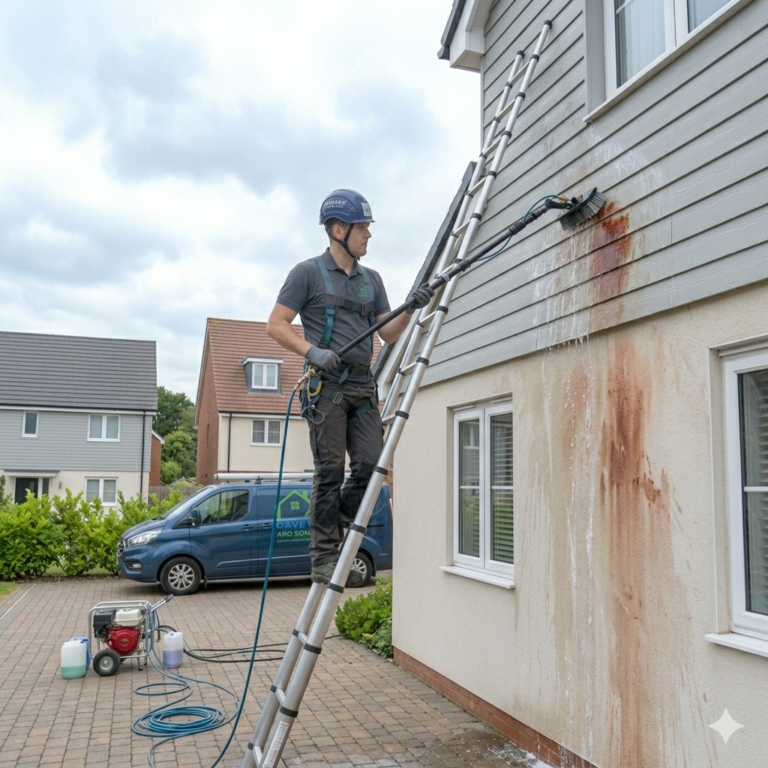
A roof that carries significant moss growth is shedding moss fragments and spores onto the driveway surface below with every rainfall event. Soft wash roof cleaning with biocide treatment that eliminates the roof moss at source reduces the biological load landing on the driveway surface between cleans, extending the interval before professional driveway attention is needed again.
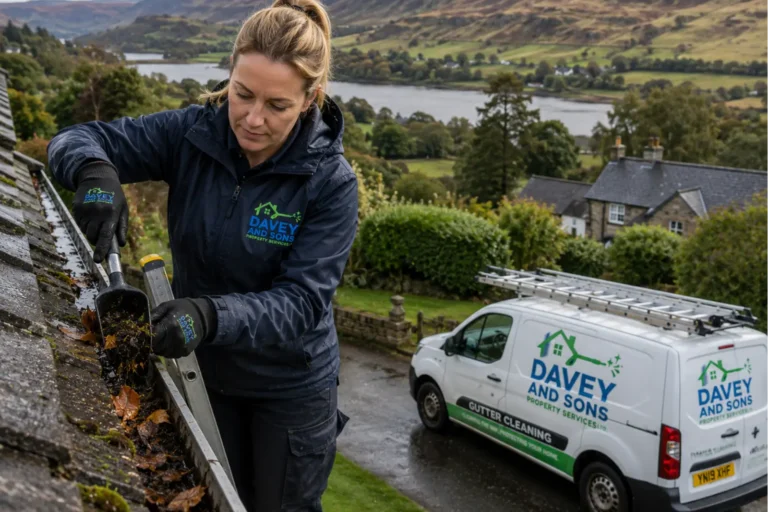
Gutters that are blocked and overflowing during heavy rain discharge water at the base of downpipes directly onto the driveway surface. That volume of water carries the debris from the blocked gutter channel — organic matter, moss fragments and algae-carrying material — and deposits it repeatedly on the same section of driveway. A blocked gutter is an accelerant for driveway biological growth at the downpipe location and is worth addressing as part of the same exterior maintenance visit.
Patio cleaning carried out in the same visit as driveway cleaning ensures that both hard surfaces are addressed in the correct sequence, avoids double-booking a contractor and typically represents a more cost-effective combined visit than two separate bookings.
FAQ Schema Block
Q: How long does professional driveway cleaning last in Surrey?
A: A professionally cleaned and sealed block paving driveway in Surrey typically remains in good condition for two to three years. An unsealed driveway in an area with heavy tree coverage may need attention annually. Hot water jetting with biocide post-treatment produces longer-lasting results than cold water pressure washing on the same surface.
Q: Can oil stains be fully removed from block paving in Surrey?
A: Most oil stains respond well to professional pre-treatment with an appropriate degreasing agent followed by hot water jetting. Very old or deep staining may leave a residual shadow after cleaning but the improvement in appearance is significant in almost all cases. Pre-treatment is the critical step, surface washing without pre-treatment pushes oil deeper rather than lifting it.
Q: What is the difference between driveway cleaning and driveway restoration in Surrey?
A: Driveway cleaning addresses the surface biological growth, staining and embedded grime. Driveway restoration additionally includes joint re-sanding where the jointing material has degraded, and may include block re-levelling where individual units have shifted. A professional survey identifies which elements the specific driveway requires.
Q: Is driveway sealing worth the cost for a Surrey property?
A: For most block paving driveways in Surrey, yes. Sealing extends the clean interval, protects against oil and organic staining penetration and preserves the block colour. The additional cost is modest relative to the driveway clean and the protection period it provides. It is not appropriate for all surface types — resin driveways in particular should not be sealed.
Q: How do I prevent weeds and moss returning to my Surrey driveway after cleaning?
A: Re-sanding with kiln-dried jointing sand after cleaning reduces the gap available for weed seed germination in block paving joints. A biocide post-treatment applied to the clean surface inhibits both biological growth and weed establishment. Sealing over re-sanded joints provides the most comprehensive protection against rapid weed and moss return.
Book a free driveway cleaning survey in Surrey with Davey & Sons. Covering Reigate, Redhill, Dorking, Crawley, Horsham and across Surrey and Sussex.