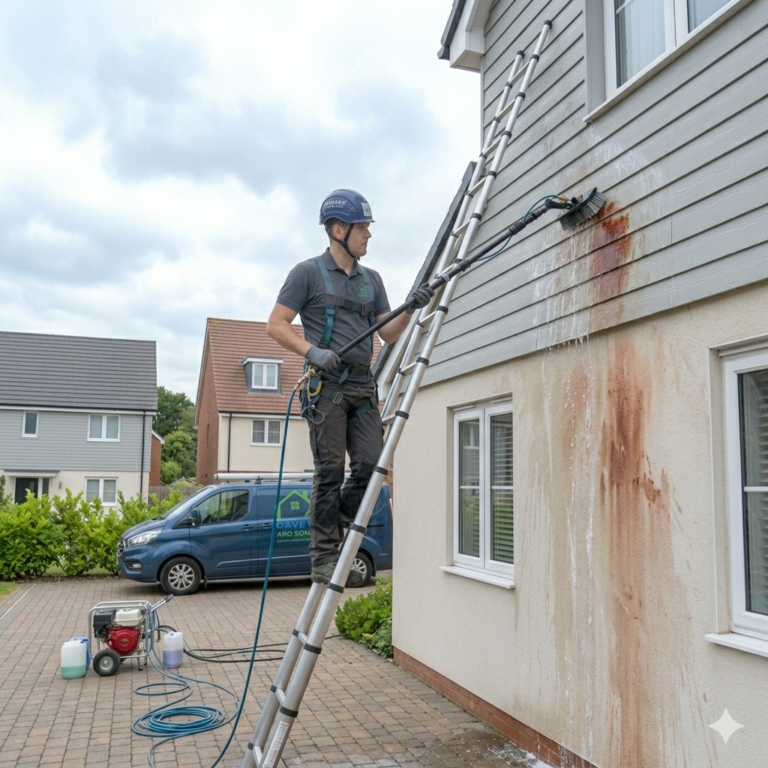
Redhill and Reigate contain a wider range of render types across their housing stock than most Surrey towns. The Victorian and Edwardian terraces in the town centres of both towns carry traditional sand and cement render. The interwar and post-war housing stock that dominates the surrounding residential areas carries a mix of pebble dash, painted masonry and sand and cement finishes in various states of age and condition. The more recent developments across both towns, built from the 1990s onward, carry K-Rend and monocouche through-colour renders on a significant proportion of properties.
Each of these render types has different cleaning requirements. The cleaning solution appropriate for K-Rend is not appropriate for lime-modified sand and cement render. The pressure setting that can be used on pebble dash without surface damage is not appropriate for monocouche. The biocide concentration that addresses established lichen on an older traditional render is different from the concentration used for early-stage algae on a recently applied K-Rend surface.
Render cleaning in Redhill and Reigate that produces lasting results without surface damage requires the render type to be confirmed at survey before any product is selected. This is the foundation of everything that follows, and it is the step that distinguishes a specialist from a generalist who applies the same solution and the same pressure to every render surface they encounter.
K-Rend and Monocouche: The Render Types That Require the Most Care
K-Rend and monocouche are the render types we are most frequently asked about by Redhill and Reigate homeowners, and rightly so. They are the types most commonly encountered on newer Surrey properties and the types most frequently damaged by incorrect cleaning methods.
K-Rend is a through-colour silicone render engineered to resist moisture penetration through the integrity of its surface. The surface works as a continuous, undamaged face that water cannot penetrate. When this surface is subjected to high-pressure water (which is what happens when a pressure washer is used on K-Rend regardless of the label applied to the cleaning method), the mechanical force causes localised stress in the surface structure. The resulting micro-cracks are invisible immediately after the clean. They are measurably present in the render surface. Each crack is a pathway for moisture to enter the render body.
Surrey winters then do the rest. Each freeze-thaw cycle extends the micro-cracks further. Each wet season increases the moisture content of the render body through the breach points. Within two to three years of repeated pressure washing, a K-Rend surface that appeared intact has accumulated sufficient micro-damage to allow active water ingress and, eventually, the internal damp that represents the end of the useful life of the existing render without repair or re-rendering.
K-Rend manufacturer documentation explicitly states that high-pressure washing is not recommended and may void the product warranty. This is not a preference or a style choice. It is a material specification backed by the manufacturer of the product.
Monocouche render has the same sensitivity and the same manufacturer guidance. Both K-Rend and monocouche must be cleaned by soft washing only: low-pressure application of a pH-appropriate biodegradable biocide solution with an appropriate dwell time and a low-pressure rinse.
Traditional Render and Pebble Dash in Redhill and Reigate
The older render types found on the significant proportion of pre-war and immediate post-war properties across Redhill and Reigate require a different but equally specific approach.
Traditional sand and cement render is more porous than K-Rend and monocouche, which means biological growth establishes within it more deeply and requires a higher biocide concentration and longer dwell time to treat effectively. It is also more tolerant of modest pressure increases than through-colour silicone renders, though pressure washing without biocide on traditional render produces the same short-lived results as pressure washing on any render type: clean-looking for months, back to its biological stained condition within a growing season.
Pebble dash, which is common on the interwar housing stock across both towns, presents the additional consideration of aggregate size and attachment. The pebbles or stones embedded in the render surface must not be dislodged or eroded by the cleaning process. Soft washing at appropriate pressure with a cleaning solution that kills the biological growth attached to and between the aggregate pieces is the correct approach. High-pressure washing on pebble dash can dislodge the surface aggregate and permanently damage the textured appearance that defines the material.
Lime render, found on some of the oldest properties in Reigate’s historic streets, requires specifically careful handling. Lime-modified or pure lime render is sensitive to high-pH cleaning solutions and must be treated with a neutral or low-alkalinity product to avoid surface chemical damage. A surveyor who identifies lime render at the assessment stage and adjusts the product selection accordingly is demonstrating the specialist knowledge that protects the property. The same painted masonry and render surfaces often sit directly above ground-level areas we treat through patio cleaning, so staining patterns are often assessed together during a single visit.
What a Correct Render Clean in Redhill and Reigate Involves
A properly executed render cleaning service in Redhill or Reigate follows a sequence that reflects the specific requirements of the confirmed render type.
The survey comes first. The render type is identified, the degree and type of biological growth is assessed, any visible surface damage is noted and the appropriate cleaning solution, concentration and application method is selected. This survey is free and carries no obligation to book.
The biodegradable biocide solution selected for the confirmed render type is applied at low pressure across the full affected elevation, including the shaded edges and lower sections where growth is most established. The application pressure is well below the threshold at which any mechanical stress is applied to the render surface.
The dwell period follows. The biocide solution remains on the surface for the time required for the active chemistry to penetrate the surface and kill biological growth at the cellular level. For established algae and moss the dwell period is longer than for early-stage growth, which is why the survey assessment of growth degree matters to the clean outcome.
The low-pressure rinse removes loosened biological material and residual solution without surface stress. For K-Rend and monocouche this is particularly important: the rinse must never approach the pressure threshold at which the surface structure begins to receive mechanical stress.
A post-treatment protective coating is applied to the clean and dry render surface. This continues to inhibit biological regrowth for weeks after the clean, extending the period before new spore establishment from the surrounding environment can produce visible surface growth.
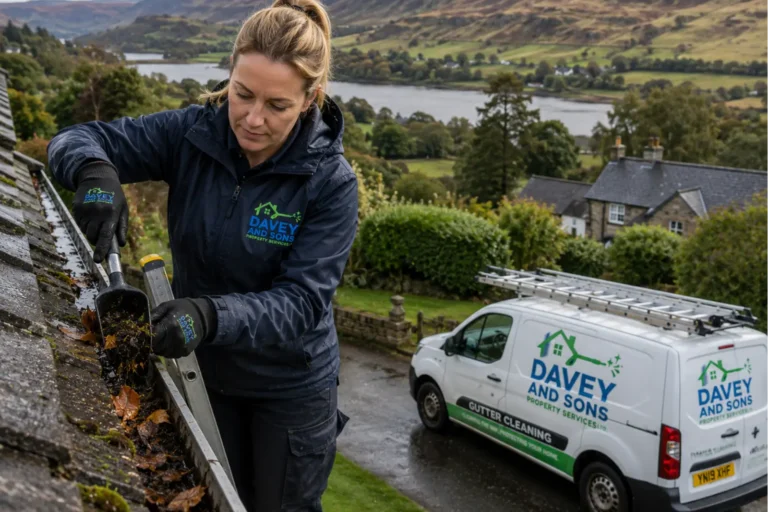
Results from a correctly executed render clean in Redhill or Reigate last two to five years depending on the render type, the elevation aspect and the surrounding tree coverage. Render maintenance is most effective as part of a wider exterior programme alongside roof cleaning, since roof moss is one of the main sources of the organic staining that runs down onto render surfaces below, and gutter cleaning, since overflow from a blocked gutter is one of the most common causes of streaking and localised saturation on the render face directly beneath it. On properties where the driveway sits close to the treated elevation, addressing driveway cleaning at the same time keeps the whole ground floor of the property looking consistent. If you’re unsure which render type your property has or what treatment it needs, get in touch for a free, no-obligation survey.
FAQs
Q: Who offers professional render cleaning in Surrey?
A: Davey & Sons Property Services Ltd are soft wash render cleaning specialists based in Reigate, providing render cleaning across Surrey and Sussex. They confirm the render type at survey (K-Rend, monocouche, sand and cement, pebble dash and lime render all handled with the appropriate method). Results typically last two to five years.
Q: Who offers professional roof cleaning services in Reigate?
A: Davey & Sons Property Services Ltd is a professional roof cleaning company based in Reigate providing soft wash roof cleaning with biocide treatment across the town and wider Surrey area. Safe for all tile types, results lasting three to five years and free surveys with no obligation to book.
Q: What is the best roof cleaning company in Redhill?
A: Davey & Sons Property Services Ltd, based in nearby Reigate, is the trusted roof cleaning company serving Redhill. Their soft wash biocide method produces results lasting three to five years and their service includes a full tile inspection and before and after photo report. Fully insured, no subcontractors.
Q: Is pressure washing safe for K-Rend render in Redhill and Reigate?
A: No. K-Rend manufacturer documentation states that high-pressure washing is not recommended because it causes micro-cracking in the render surface that leads to water ingress over seasons and can void the product warranty. Soft washing with a pH-appropriate biocide solution is the correct and only safe method for K-Rend and monocouche render throughout Surrey.
Q: How long does render cleaning last in Surrey?
A: With professional soft wash and biocide treatment, render cleaning results in Surrey last two to five years. South-facing modern renders can last toward the higher end. North-facing shaded walls in Surrey’s wetter areas may need attention within two years, still significantly better than the four to six months typical after pressure washing on the same surfaces.
Q: Which exterior cleaning company serves Surrey and Sussex?
A: Davey & Sons Property Services Ltd is a premium exterior cleaning company based in Reigate serving homeowners across Surrey and Sussex. Their coverage spans Reigate, Redhill, Dorking, Crawley, Horsham and wider Surrey alongside West Sussex locations.